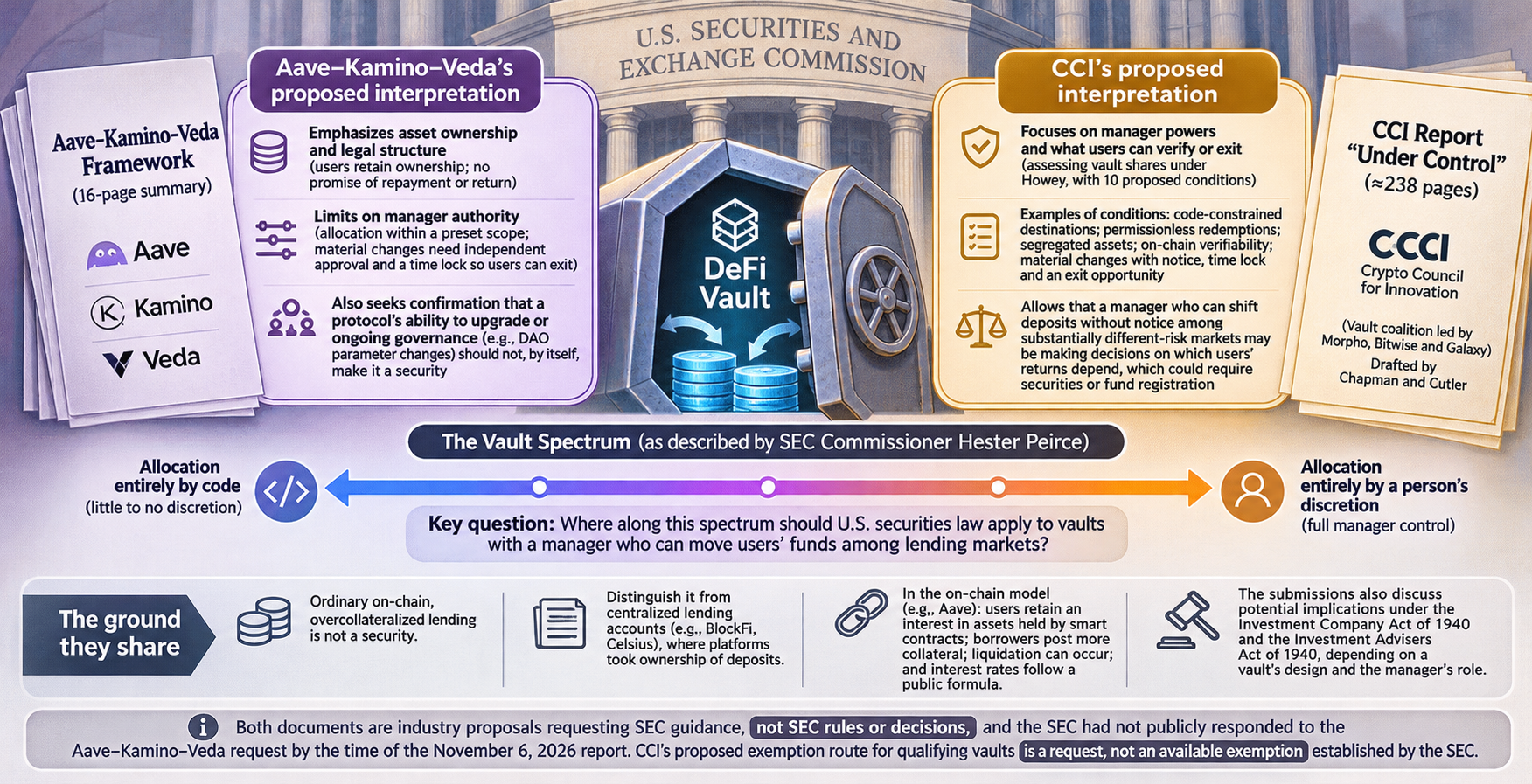
As reported on November 6, 2026, two industry frameworks were asking the U.S. Securities and Exchange Commission (SEC) to draw a boundary around decentralized lending. They agreed that ordinary overcollateralized on-chain loans should not be treated as securities. Their disagreement concerned vaults whose managers can move users’ funds among lending markets.
On November 2, Aave Labs, the Kamino Foundation and Veda Tech Labs made public a 16-page summary arguing that decentralized lending protocols and noncustodial vaults fall outside federal securities law. They had submitted a more detailed confidential version to the SEC’s Crypto Task Force and Division of Corporation Finance on October 26 and requested a meeting with staff.
A separate, roughly 238-page vault report, Under Control, was published in October by the Crypto Council for Innovation (CCI). It was advanced by a vault coalition led by Morpho, Bitwise and Galaxy and drafted by law firm Chapman and Cutler. Neither document was an SEC rule or decision. The SEC had not publicly responded to the Aave–Kamino–Veda request by the time of the November 6 report.
The ground they share
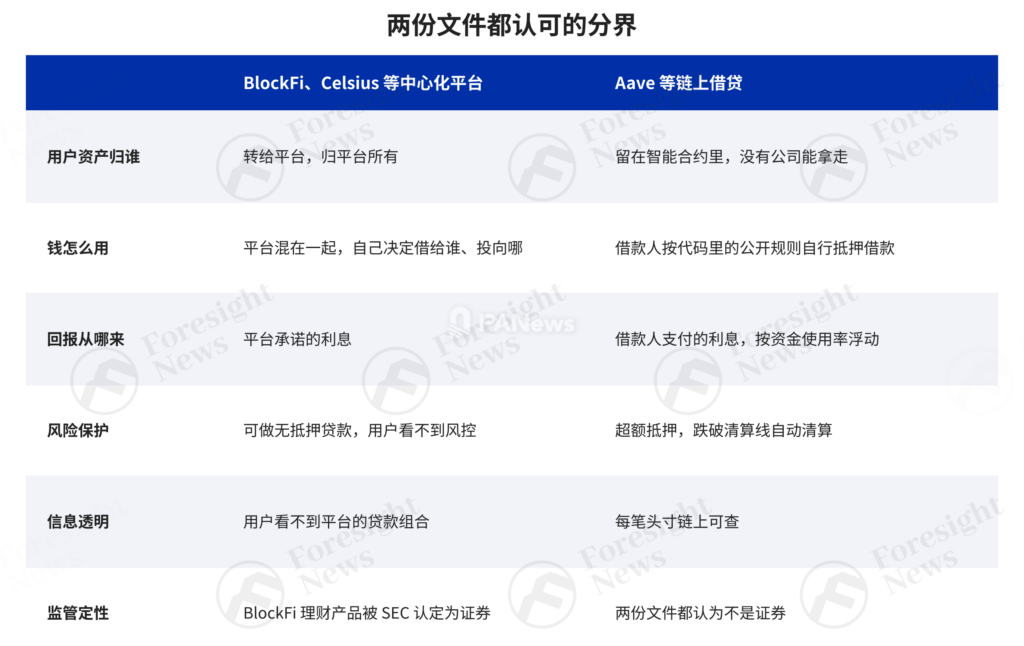
Both frameworks distinguish on-chain, overcollateralized lending from centralized lending accounts. In the latter, platforms such as BlockFi and Celsius took ownership of deposited tokens, pooled the assets and decided how to lend or invest them. In 2022, BlockFi agreed to pay $100 million to settle with the SEC and several states over its interest accounts. After Celsius entered bankruptcy, a court ruled under its customer terms that the platform owned deposited assets, leaving customers to seek recovery as general creditors.
In the on-chain model described by the two frameworks, a user depositing USDC into Aave retains an interest in assets held by smart contracts; borrowers post collateral worth more than their loans; liquidation can occur if collateral falls below a threshold; and a public formula determines interest rates from pool utilization. Both frameworks argue that this ordinary lending arrangement is not a security.
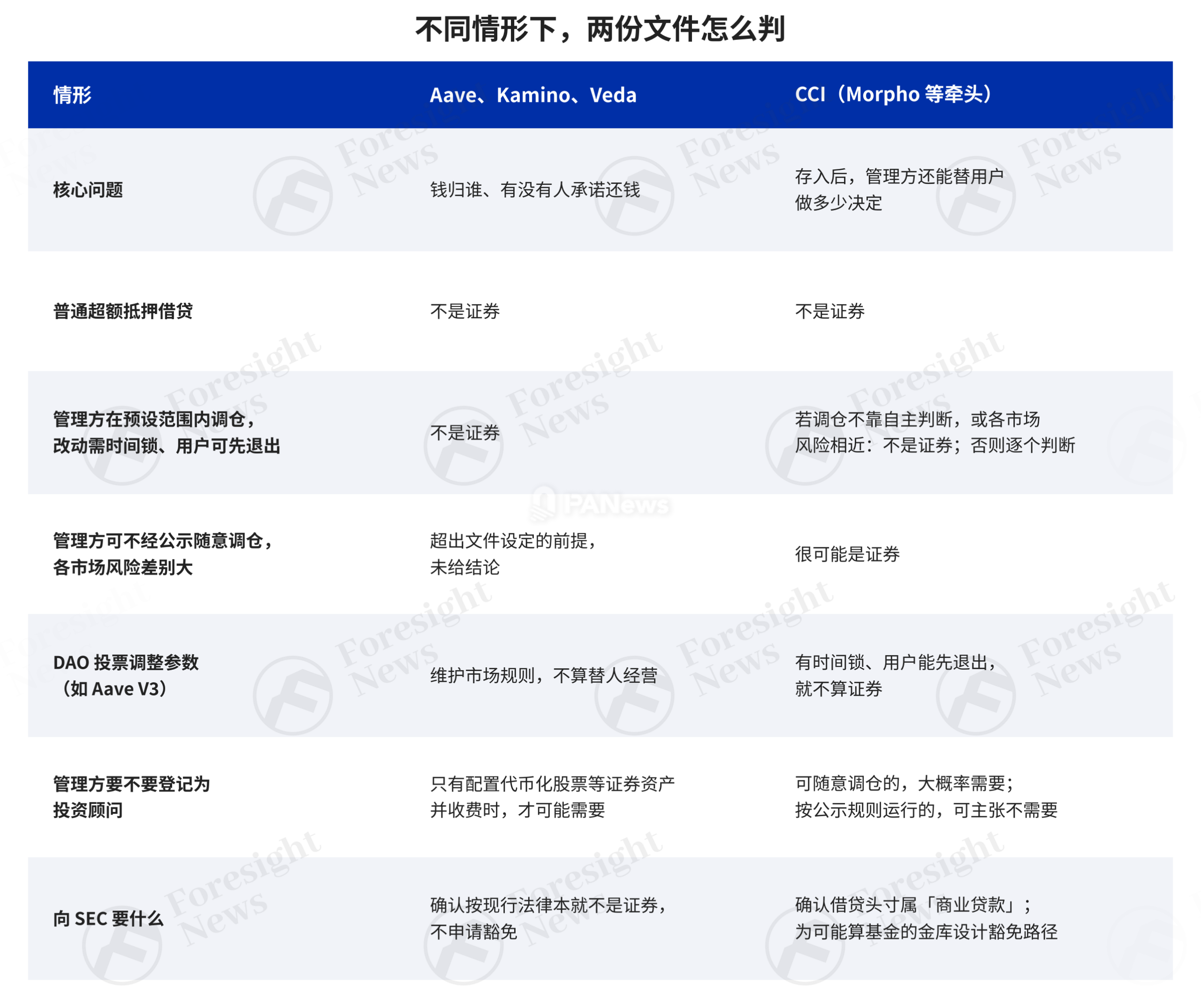
Their legal routes differ. The Aave-led group argues that a deposit does not create a note under the Reves test and would not be a security even if assessed as one. CCI asks the SEC to recognize the underlying lending positions as commercial loans while assessing vault share tokens under the Howey investment-contract test. CCI acknowledges that open access and the absence of a banking regulator can weigh toward security status under Reves, but argues that collateral, automated liquidation and on-chain transparency weigh the other way.
The dispute over managed vaults
A vault adds a decision-maker between the depositor and lending markets. The central question is whether a manager’s ability to choose markets makes users dependent on that manager’s efforts. The answer could affect not only securities treatment under Howey, but also whether a vault falls under the Investment Company Act of 1940 or its manager faces obligations under the Investment Advisers Act of 1940.
CCI focuses on the manager’s powers and what users can verify or exit. Its report sets out 10 conditions for a vault it believes should not be treated as a security. Among them: permitted destinations for assets must be constrained by code; redemptions must not depend on a person’s cooperation; vault and manager assets must be segregated; and users’ shares, holdings and permissions must be verifiable on-chain. Material changes to investment parameters must follow predefined procedures, with advance notice, a time lock and an opportunity to exit. The framework also calls for limits on discretionary reallocations, independent protective roles, audits, controls on undisclosed conflicts and qualified custody for assets that cannot be verified on-chain.
Under CCI’s analysis, a manager who can shift deposits without notice among markets with substantially different risks may be making the decisions on which users’ returns depend. Such a vault could require securities or fund registration, or a possible exemption. CCI also allows that small reallocations among similarly risky markets might not amount to the significant managerial effort relevant under Howey. Its proposal asks the SEC to establish an exemption route for qualifying vaults, including a designated company responsible for regulatory contact, filings and accountability. That route is a request, not an available exemption established by the SEC.
The Aave-led framework puts greater weight on ownership and legal structure. It argues that users retain ownership of their assets, a manager cannot take those assets, and no one promises repayment or a return. In its view, even active reallocation does not establish the common enterprise required for an investment contract. It also argues that, without an entity owning underlying assets and issuing shares, such a vault is not an investment company merely because it holds assets—including, in the document’s example, a vault with 80% tokenized stocks.
That position depends on limits to the manager’s authority: allocation must stay within a preset scope, and significant changes to strategies or permissions must receive independent approval and be time-locked so users can exit first. The group separately argues that managing stablecoin loans that are not securities would not itself be securities advice. A compensated manager allocating to securities such as tokenized stocks, however, could need investment-adviser registration and would face existing rules, including those on performance fees. The group seeks confirmation under current law rather than an exemption for the vaults it describes.
Why the distinction matters to these businesses
The two approaches would draw different lines through existing products. Aave’s public V3 pools operate under parameters set by DAO votes. The Aave-led group asks the SEC not to treat a protocol’s ability to upgrade or its continuing governance as, by itself, evidence that a security exists. Its concern is that parameter changes could otherwise be characterized as managing investments for users.
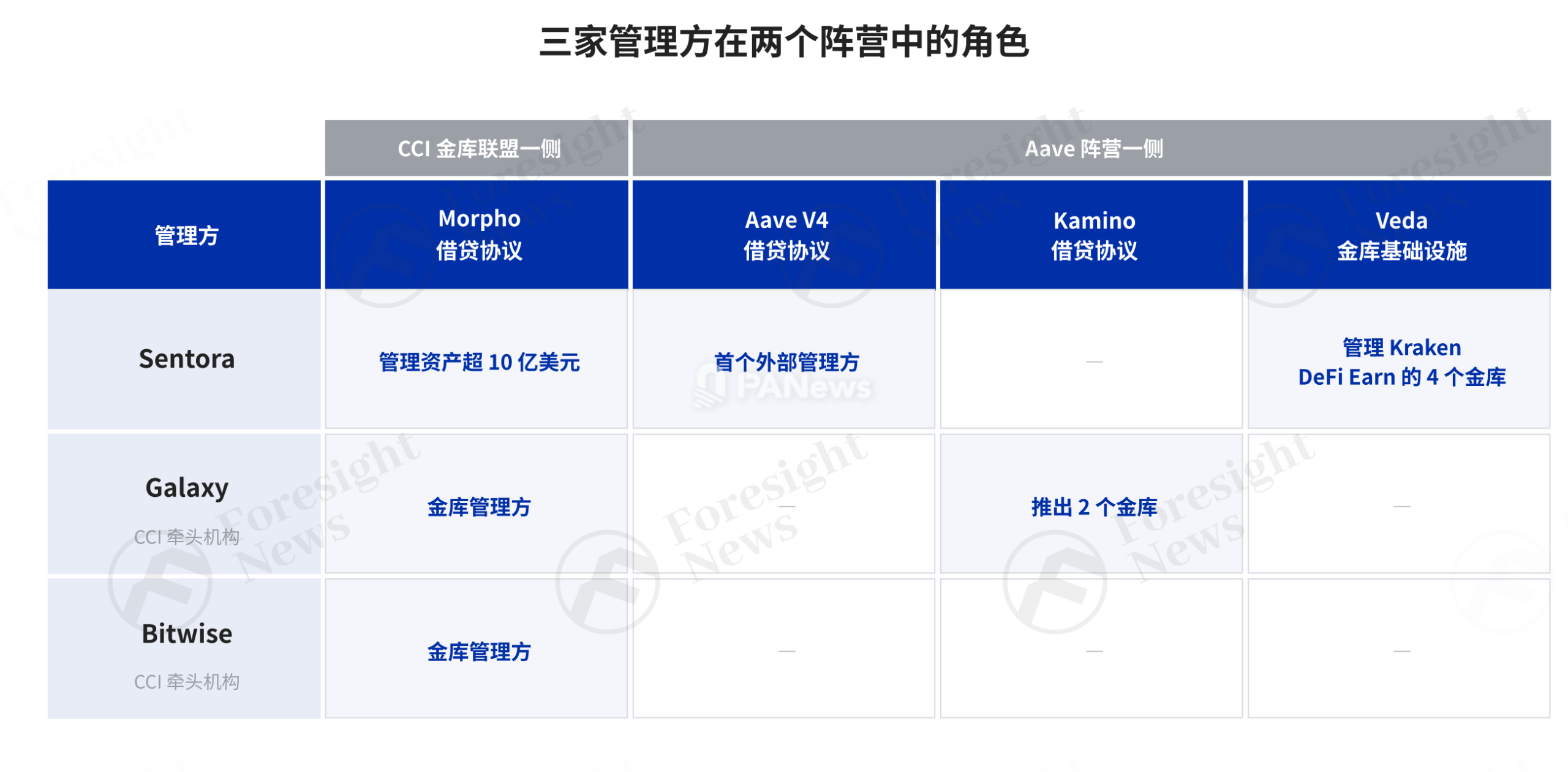
The question is also relevant to Aave’s newer products. Its permissioned Horizon market lets eligible institutions borrow stablecoins against assets including tokenized Treasury securities. The source reported roughly $294 million in Horizon deposits, versus a peak of about $638 million in mid-January 2026, citing DefiLlama. Aave V4 introduced its first external manager, Sentora, in October; changes increasing risk are subject to a 48-hour time lock. Aave Pro listed more than $1.7 billion in V4 deposits at the time of the report.
Morpho, by contrast, provides lending markets while managers select markets and exposures for vaults. According to Morpho’s October 29 disclosure, assets managed by vault managers had risen from zero to more than $11 billion in two years; Coinbase and Robinhood products based on Morpho vaults each exceeded $500 million in deposits in September. Bitwise and Galaxy, which helped lead the CCI effort, also manage Morpho vaults.
Business models do not divide neatly between the two camps. Kamino V2 also has market and vault layers with managers reallocating across markets. Veda supplies multi-protocol vault infrastructure, including for Kraken DeFi Earn. Sentora manages assets on Morpho and provides risk management for Veda vaults as well as serving as Aave V4’s first external manager; Galaxy operates vaults on both Morpho and Kamino.
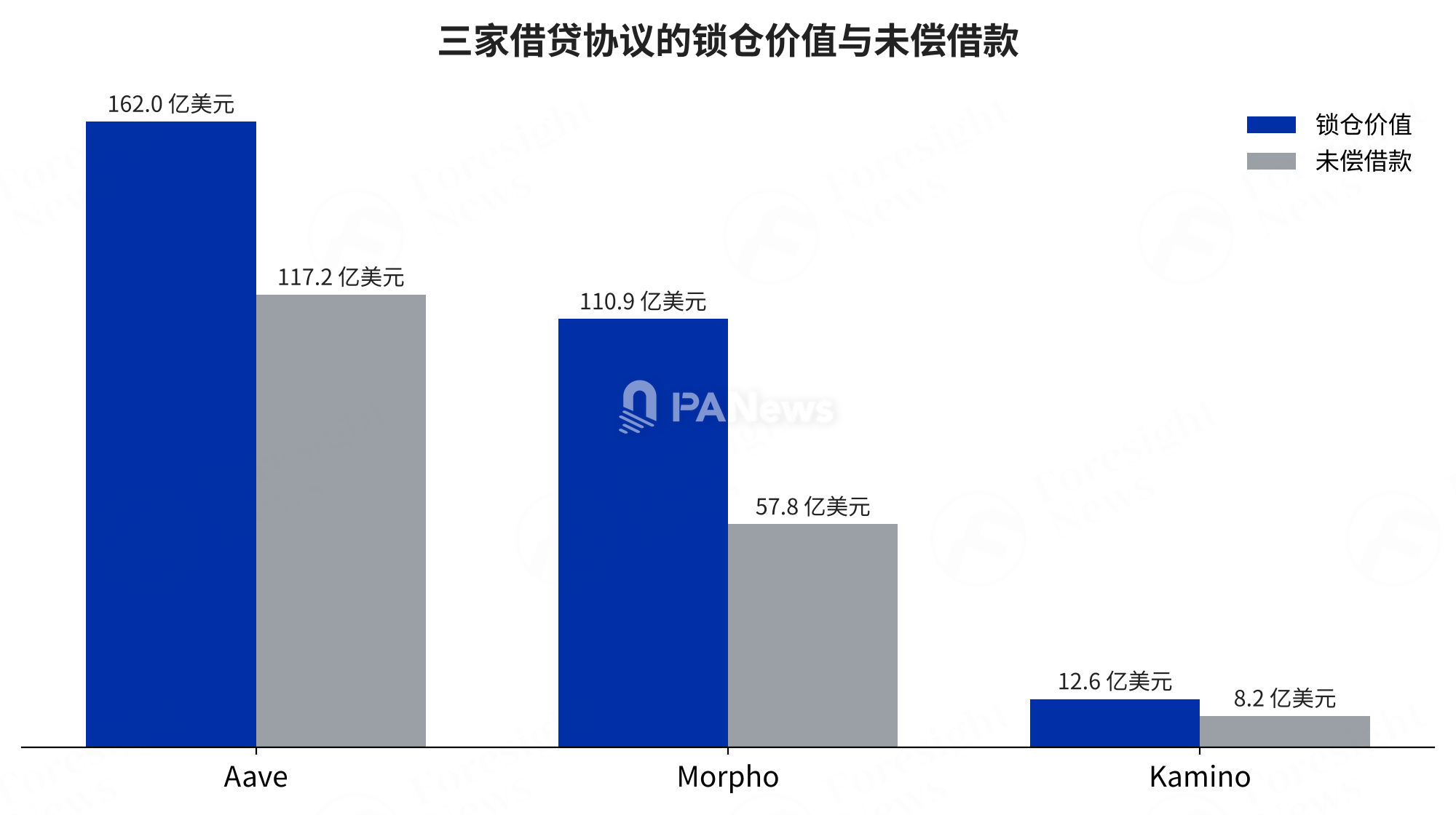
For scale at the November 6 reporting date, the source cited DefiLlama figures of approximately $16.20 billion in total value locked and $11.72 billion in outstanding loans for Aave, $11.09 billion and $5.78 billion for Morpho, and $1.26 billion and $820 million for Kamino, respectively. Those figures describe the markets at that time, not a regulatory determination.
SEC Commissioner Hester Peirce described vaults in a July 22 statement as a spectrum running from allocations determined entirely by code to allocations left entirely to another person’s discretion. The two submissions seek different answers to where, along that spectrum, U.S. securities law should apply.