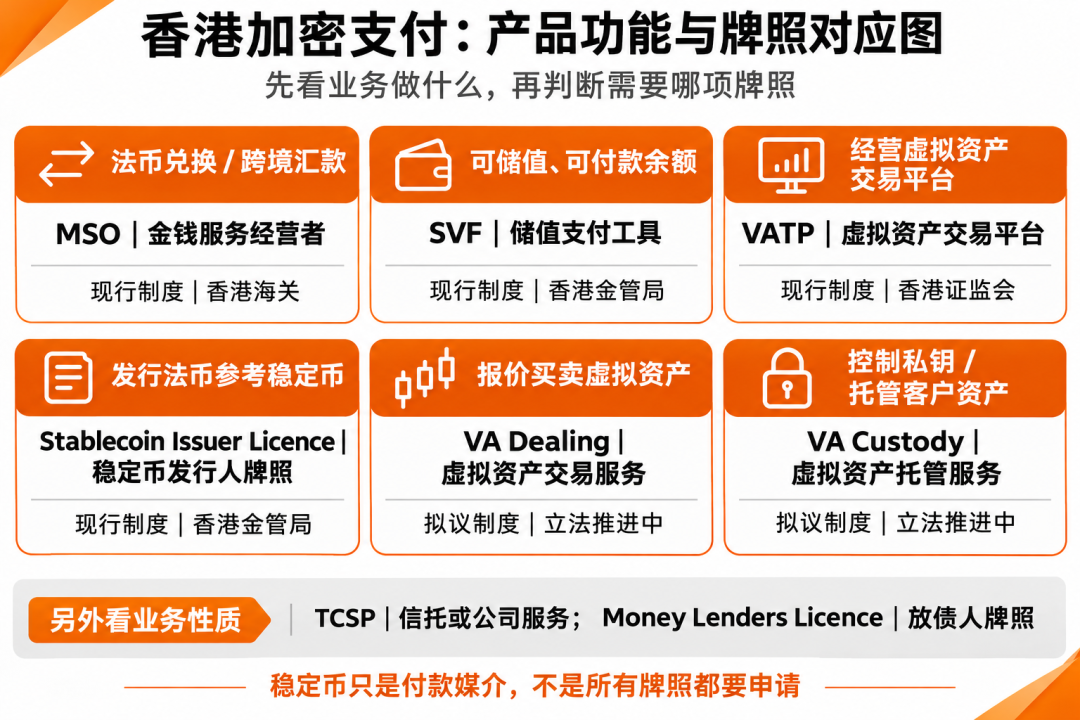
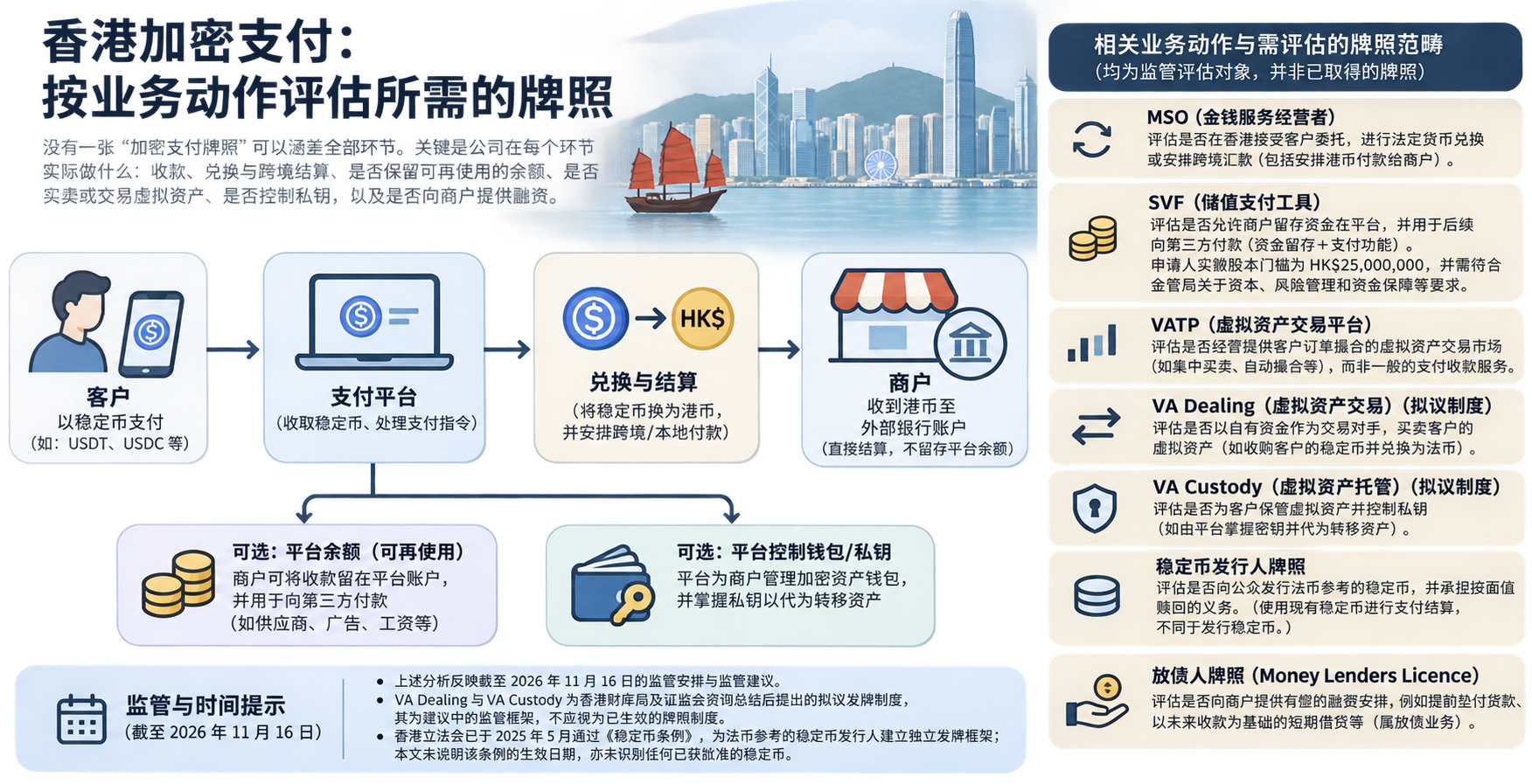
A crypto payment product does not have a single, all-purpose licence in Hong Kong. The relevant question is what the company does at each step: receive funds for a customer, arrange a fiat payout, hold a balance for later payments, trade virtual assets, control private keys or lend to merchants.
Reporting context: 16 November 2026. The licensing analysis below reflects the arrangements and regulatory proposals discussed at that time; proposed virtual-asset dealing and custody regimes should not be treated as licences already in force.
Fiat settlement and merchant balances
A Money Service Operator (MSO) licence concerns fiat-currency exchange and remittance. If a payment company receives a customer’s instructions and arranges a cross-border Hong Kong-dollar payment to a merchant, its role needs to be assessed even if a bank makes the final transfer. Converting a stablecoin into Hong Kong dollars is not, by itself, the fiat-to-fiat exchange authorised by an MSO licence, nor does that licence automatically authorise virtual-asset trading. A company that uses a licensed MSO for settlement still needs to examine which party undertakes each obligation under their agreement.
A Stored Value Facility (SVF) licence raises a different question: can a merchant leave proceeds on the platform and use that balance to pay third parties? The presence of an account balance alone is not the decisive point; retained value combined with further payment functionality is the concern. The source identifies a minimum paid-up share capital requirement of HK$25 million for an SVF applicant, alongside Hong Kong Monetary Authority requirements concerning financial resources, risk management and safeguarding funds. A design that sends proceeds to the merchant’s external bank account, rather than making them available for onward payments within the platform, presents a different licensing analysis.
Trading, issuing and controlling virtual assets
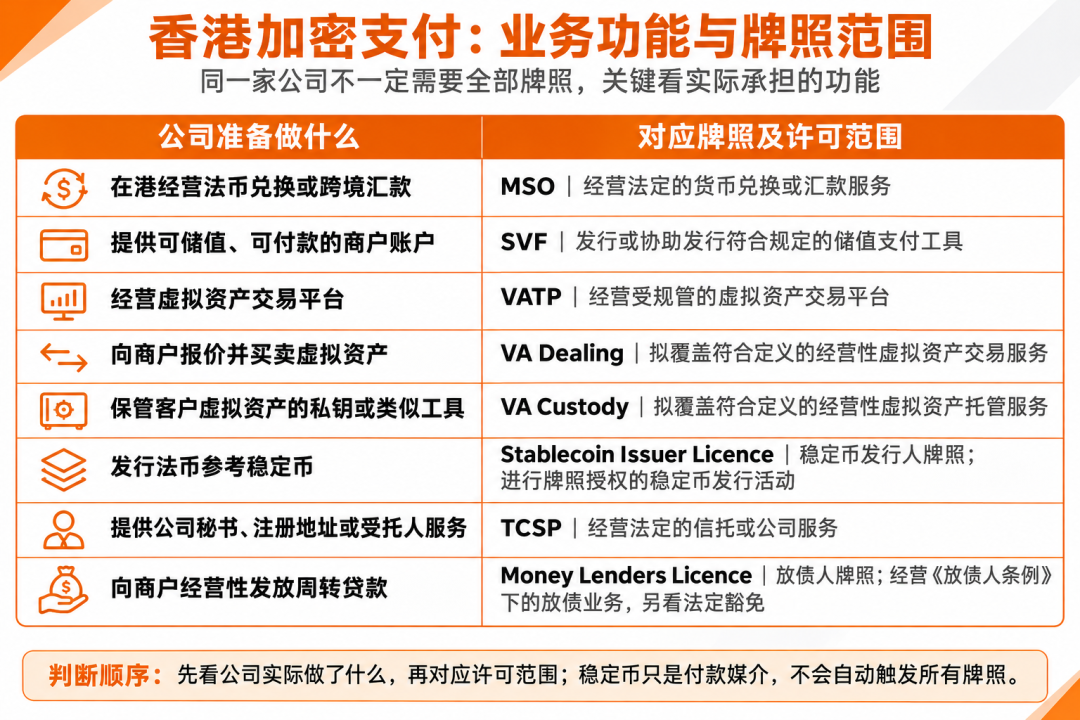
A Virtual Asset Trading Platform (VATP) licence addresses the operation of a trading platform, not every payment service that handles stablecoins. Whether a product provides a market where customers’ orders are matched matters. A company that buys stablecoins from customers as principal or offers over-the-counter conversion, however, must assess that activity separately; it cannot assume an MSO licence covers it.
The source describes separate VA Dealing and VA Custody licensing regimes as proposals following a consultation summary by Hong Kong’s Financial Services and the Treasury Bureau and Securities and Futures Commission. Their proposed status matters. A payment company acting as the counterparty to a customer’s stablecoin sale, or holding the private keys needed to move a merchant’s assets, should account for those activities and the developing rules rather than treating them as incidental payment functions.
Hong Kong’s Legislative Council passed the Stablecoins Ordinance in May 2025, establishing a separate licensing framework for fiat-referenced stablecoin issuers. Using an existing stablecoin for settlement is distinct from issuing one and undertaking its redemption obligations. The article does not establish an effective date for the ordinance or identify any approved stablecoin.
Merchant financing
A Money Lenders Licence may become relevant if early settlement develops into paid financing—for example, where a platform advances its own funds against a merchant’s future receipts. The source identifies Hong Kong’s Money Lenders Ordinance as the applicable framework and distinguishes lending from the payment service itself.
For a company planning a Hong Kong launch, the practical starting point is to map who receives and sends fiat money, whether merchants can reuse balances, who trades the stablecoin, who controls the keys and whether any advance is a loan. Those documented roles—not the label “crypto payments”—determine which existing licensing requirements and proposed regimes warrant examination.