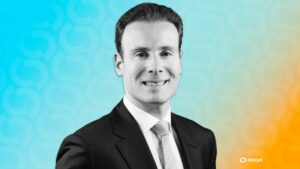
Sir Nicholas Lyons, chairman of Standard Life, wants the UK’s planned digital government bond pilot to help ordinary savers buy gilts, rather than primarily serving large financial institutions. Speaking at Solana’s Breakpoint conference in London, he asked why buying the bonds that fund public spending should be so complicated for retail investors.
As reported on November 17, 2026, the UK was preparing its first digitally native government bond, known as DIGIT. The Treasury had confirmed roles for six banks supporting the pilot earlier that month. Lyons said issuance was expected in the first quarter of 2027; the pilot was not yet an issued bond.
Lyons argued that tokenization could lower administrative costs, simplify transfers and make smaller investments economical. He said roughly £850 billion ($1.1 trillion) of UK household wealth remained in cash, often losing value to inflation. In his view, broader retail ownership of gilts could reduce reliance on foreign buyers and help diminish the risk premium on UK debt since the September 2022 mini-budget. Those are potential outcomes he advanced, not established effects of the pilot.
He also said an effective test of issuing, settling and using tokenized gilts as collateral could support wider digital capital markets. Lyons credited the Financial Conduct Authority, the Bank of England and the Treasury for work including the Digital Securities Sandbox and efforts concerning tokenized collateral. Citing a July report by the government’s wholesale digital markets champion, Chris Woolard, he said faster adoption of digital markets could add up to £33 billion ($43.5 billion) annually to UK economic output by 2035.
Lyons identified four priorities: make DIGIT work, accelerate tokenized collateral and repo markets, ensure digital platforms can interoperate, and include retail investors in the benefits. He cautioned, however, that tokenization does not itself make an investment safer, more liquid or suitable for retail buyers: fractional ownership of a risky asset remains risky.