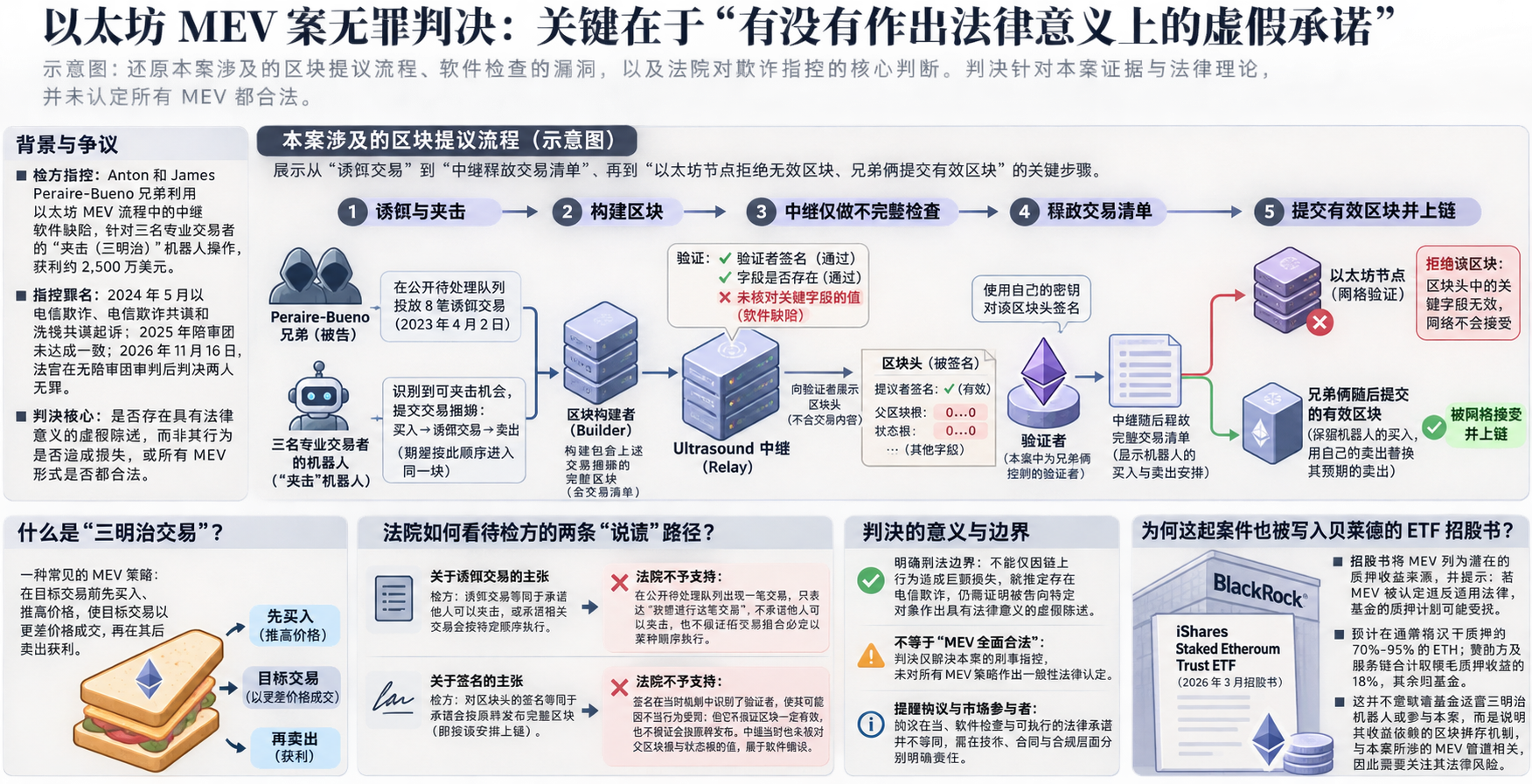
A US federal judge acquitted Anton and James Peraire-Bueno on November 16, 2026, in a case arising from a disputed Ethereum transaction-ordering strategy. As reported on November 19, the ruling turned on whether the brothers had made a legally significant false representation—not on whether their conduct caused losses or whether all forms of maximal extractable value (MEV) are lawful.
Prosecutors alleged that the brothers obtained roughly $25 million in an operation targeting three professional traders whose bots sought to profit from sandwich trades: placing a purchase before another transaction and a sale after it. The prosecution brought wire-fraud, wire-fraud-conspiracy and money-laundering-conspiracy charges in May 2024. A 2025 jury trial ended without a unanimous verdict; the acquittal followed a trial without a jury.
What the court examined
According to the court record, the brothers placed eight bait transactions in Ethereum’s public pending-transaction queue on April 2, 2023. When bots submitted transaction bundles designed to sandwich those trades, the brothers used a defect in the Ultrasound relay’s checks to obtain the bundles’ contents. They then proposed a valid block that retained the bots’ purchases but replaced the expected subsequent trades with their own sales.
The disputed step involved a signed block header with zeroes in two fields that should have contained specific values. The relay checked the proposer’s signature but did not verify those values before releasing the full transaction list. Ethereum nodes would not accept the invalid block described by that header.
Prosecutors argued that the bait transactions and signed header conveyed promises about how the block would be published. The judge rejected both theories: a pending transaction did not promise that others could sandwich it or that a bundle would execute in a particular order, while the signature identified the validator without guaranteeing that the proposed block was valid or would be published unchanged. The judge also found that concealment, exploitation of the software defect and later transfers did not substitute for the material false representation required for the wire-fraud charges. The money-laundering-conspiracy charge depended on proceeds from that alleged fraud.
Why the ruling matters beyond the defendants
BlackRock’s March 2026 prospectus for the iShares Staked Ethereum Trust ETF identifies MEV as a potential source of staking revenue and warns that a finding that MEV violates applicable law could disrupt its staking program. The document anticipates staking approximately 70%–95% of the fund’s ETH under normal circumstances and says the sponsor and service chain together receive 18% of gross staking rewards, with the remainder retained by the fund.
That disclosure does not say the fund operates sandwich bots or participated in this case. Nor did the acquittal classify every MEV strategy or grant the industry general legal approval. It resolved the criminal charges against these defendants on the evidence and legal theories before the court. The prospectus separately describes contractual obligations for validators, illustrating a distinction central to the case: a protocol signature, a software check and an enforceable promise are not necessarily the same thing.