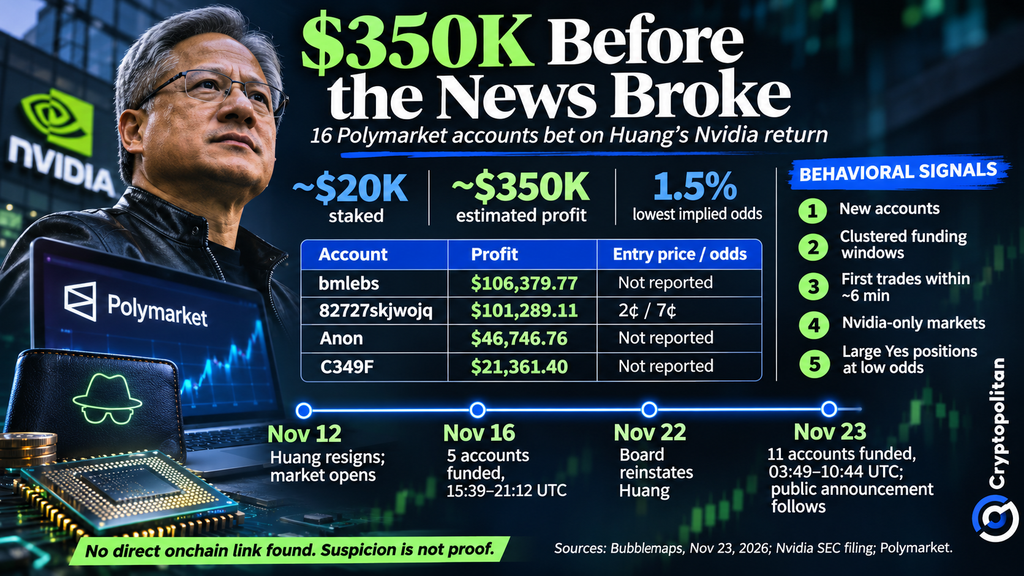
Reporting dated November 24, 2026 described how blockchain analytics firm Bubblemaps identified 16 Polymarket accounts that made roughly $350,000 in profit from about $20,000 in bets on Jensen Huang’s return to Nvidia. Bubblemaps said the bets were placed before Nvidia’s announcement on November 23 and were traced through Polymarket’s public blockchain records. Those records do not establish whether the traders had any advance knowledge.
Funding clusters and the largest accounts
In a report released on November 23, Bubblemaps split the activity into two sets by funding time. Five accounts were funded between 15:39 and 21:12 UTC on November 16. The other 11 were funded between 03:49 and 10:44 UTC on November 23, hours before Nvidia announced Huang’s return.
All 16 accounts were new, and their bets were confined to Nvidia-related events. Some bought “Yes” shares when the market put the chance of Huang’s return at 1.5%.
Four accounts accounted for most of the profit:
- bmlebs: $106,379.77
- 82727skjwojq: $101,289.11
- Anon: $46,746.76
- C349F: $21,361.40
The account 82727skjwojq made an early $3,180 bet that Huang would be back before the end of November, buying shares at 2 cents. That stake paid $88,168. The same account also staked $2,287 on a December return, at 7 cents a share, and was paid $21,932.
What the records do not show
The timing prompted questions, but Bubblemaps reported no link among the 16 accounts. It also noted that the accounts generally began trading only about six minutes after the deposits arrived. Whether any of the traders knew of Huang’s return beforehand is unknown.
A Cambridge MPhil thesis dated June 2026, by Yasith Disanayaka Medagama Disanayakage, described a system for flagging suspected insider trading. It detected 16 of 22 cases that had already been reported and was described as analyzing more than 130,000 trades per second. The thesis treated profits that look too high as insufficient, by themselves, to decide whether the trading was lawful.
In a working paper published in August 2026, Jonathan Macey of Yale University and Luca Enriques of Bocconi University argued that informed traders can help prediction markets produce better forecasts. They proposed excluding contracts open to manipulation, rather than barring informed trading outright. That was an academic proposal, not a rule change.

The reinstatement and reported market moves
Huang’s return came 10 days after he stepped down on November 12 amid controversy over his personal relationships. Nvidia’s SEC filing said the board reinstated him as president and chief executive on November 22. The company announced the decision the following day.
Reuters reported that Nvidia shares closed 31% higher, that the Nasdaq 100 gained 6.5%, that the S&P 500 rose 4.7%, and that Europe’s STOXX 600 climbed 1.8%.
On Polymarket, contracts tied to Huang’s return drew $12.4 million in trading volume. Bettors could also be paid if he returned to Nvidia in a formal role other than chief executive.
Policy debate, not a new prohibition
In a July 29 legal advisory, Weil, Gotshal & Manges warned that insiders could profit from confidential corporate information without buying or selling the company’s shares. Given uncertainty over how existing securities laws apply, the firm proposed that companies extend insider-trading policies to prediction markets. That advisory is a recommendation, not an enacted rule.
The European Securities and Markets Authority’s September risk monitor highlighted market manipulation, limited identity verification, and a lack of investor protection. The account of that monitor does not describe a new ban.
In the United States, Representatives Sean Casten and Ted Lieu introduced H.R. 11092 on November 19. The bill would award whistleblowers 10% to 30% of monetary sanctions in qualifying enforcement cases exceeding $1 million. Introduction is not enactment.
On the Huang contracts, blockchain analytics could flag concentrated and closely timed bets. Showing that a trader illegally used confidential information is a separate matter, and Bubblemaps did not claim to have established that.