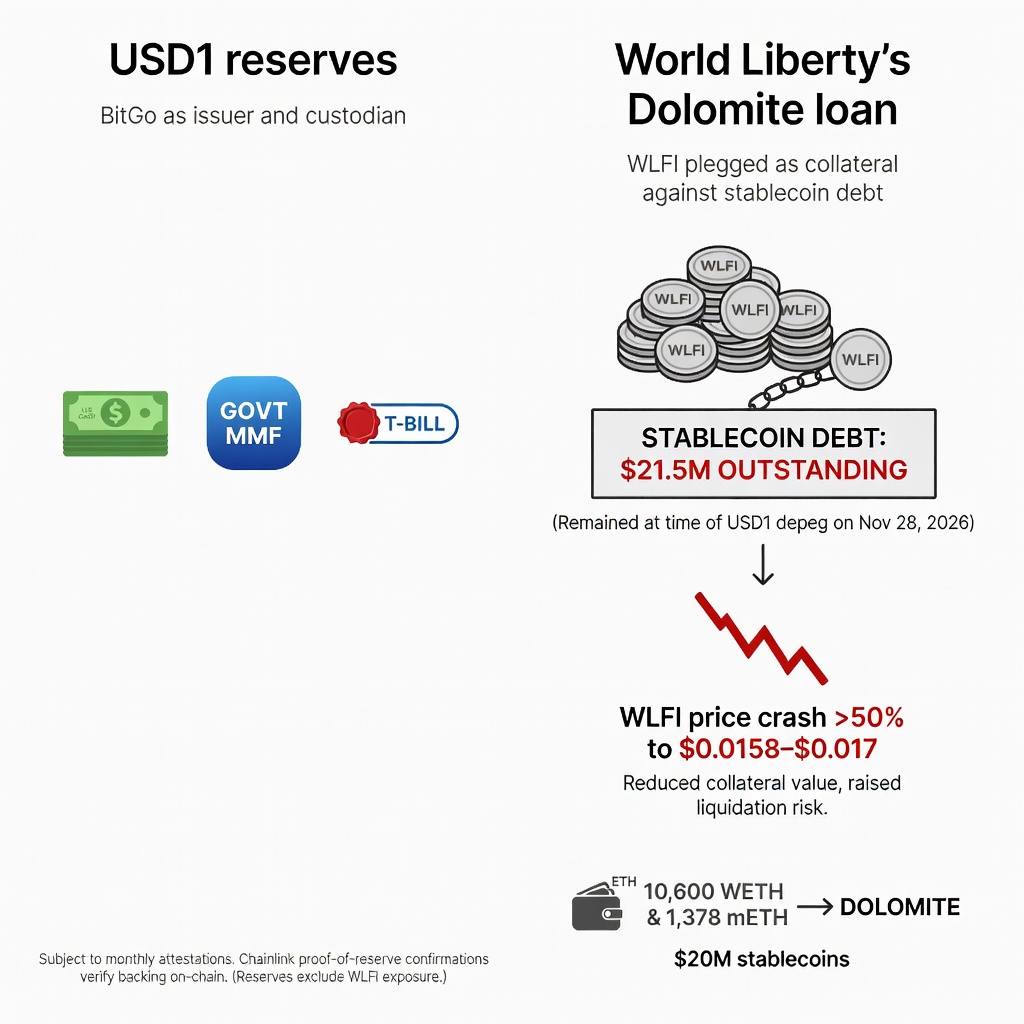
World Liberty Financial’s USD1 stablecoin traded as low as $0.94 on Binance on November 28, 2026, before recovering to about $0.99. The drop followed a large withdrawal from Dolomite, a lending protocol where World Liberty had borrowed stablecoins against its own governance token, WLFI. That token served as collateral for the loan, not as backing for USD1.
The loan exposed to WLFI’s price
World Liberty had borrowed approximately $75 million in stablecoins on Dolomite in April 2026. About $21.5 million remained outstanding when USD1 slipped below its dollar peg. WLFI fell more than 50% to a record low reported at between $0.0158 and $0.017, reducing the value of the collateral and increasing the risk of liquidation.
A reserve wallet linked to the project reportedly swapped approximately 10,600 WETH and 1,378 mETH for about $20 million in stablecoins to avoid liquidation. Most of the proceeds reportedly went to Dolomite.
Redemptions and reserve backing
BitGo, USD1’s issuer and custodian, processed more than $110 million in USD1 redemptions on Ethereum in the 24 hours surrounding the price drop. Arbitrage trading, including activity by Jump Crypto, helped bring the Binance price back toward $1. In the month before the episode, USD1’s market capitalization had already fallen by approximately $1 billion to about $2.8 billion.
USD1’s reserves consist exclusively of US cash, government money market funds and short-term US Treasuries. They are subject to monthly attestations, and Chainlink proof-of-reserve confirmations are intended to let holders verify the backing on-chain. Those checks cover the stablecoin reserves, not World Liberty’s treasury decisions. The separate oversight question for BitGo is how closely it monitors that wider activity, including World Liberty’s borrowing against WLFI.