As reported on Nov. 13, 2026, the US Department of Justice, business groups and a coalition of decentralized finance (DeFi) firms had filed court papers opposing Illinois’ digital asset tax. Their arguments support legal challenges brought by crypto industry associations; the tax had not been struck down.
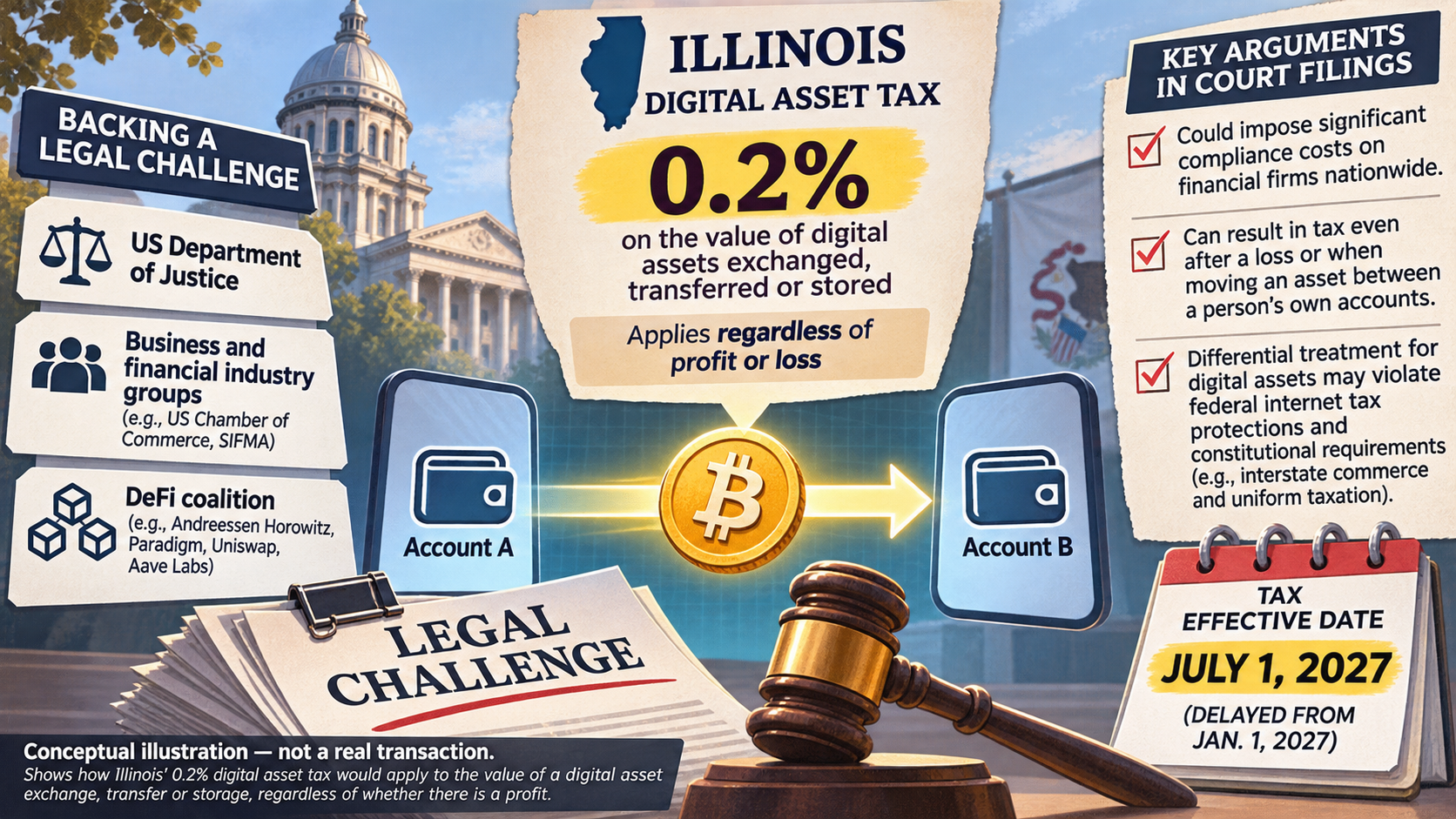
Illinois enacted the measure in June 2026. It imposes a 0.2% tax on the value of digital assets exchanged, transferred or stored, whether or not a transaction produces a profit. Originally set to take effect on Jan. 1, 2027, it was delayed until July 1, 2027. The governor’s budget office had projected $60 million in revenue for fiscal year 2027.
The Digital Chamber sued Illinois Attorney General Kwame Raoul and state revenue official David Harris in July. The Blockchain Association and Crypto Council for Innovation filed a separate challenge in August.
Objections from business groups and the Justice Department
In a Nov. 6 filing, the US Chamber of Commerce and the Securities Industry and Financial Markets Association argued that the tax could impose compliance costs on banks, broker-dealers, custodians and asset managers nationwide. They said customers could owe tax after a loss or when moving an asset between their own accounts. The groups also argued that taxing digital asset services differently from comparable traditional-asset transactions could violate federal internet tax protections and constitutional requirements governing interstate commerce and uniform taxation.
The Justice Department filed a statement of interest on Nov. 6, arguing that less favorable tax treatment for digital assets could conflict with federal efforts to promote the sector. It cited the Strategic Bitcoin Reserve and the GENIUS Act’s federal stablecoin rules.
DeFi coalition questions proposed collection rules
In a Nov. 11 filing, a coalition including Andreessen Horowitz, Paradigm, Uniswap and Aave Labs argued that Illinois’ proposed rules could place tax-collection obligations on software developers and other blockchain participants who lack customer information, control over users’ funds or the ability to collect the tax.
Illinois House Speaker Emanuel “Chris” Welch had promoted the measure as part of an affordability agenda, saying it would make major technology companies and wealthy crypto investors pay their fair share, according to a July Chicago Tribune report. Lawmakers involved in advancing the legislation and the governor’s office did not respond to requests for comment before the original report was published.