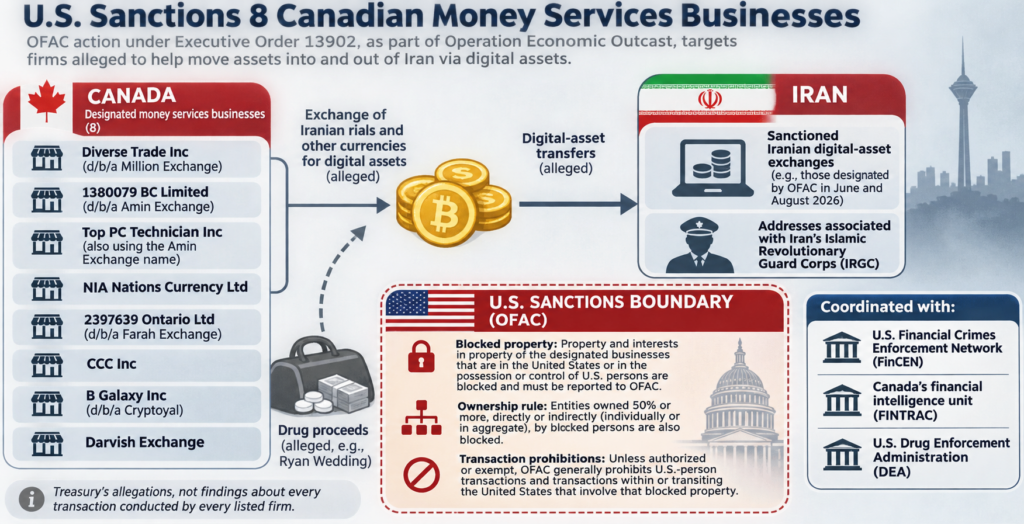
In a release recorded as published on November 7, 2026 (UTC+8), the U.S. Treasury said its Office of Foreign Assets Control (OFAC) had sanctioned eight Canadian money services businesses under Executive Order 13902. Treasury alleges that the firms helped move assets into and out of Iran by exchanging Iranian rials and other currencies for digital assets. The designations were part of its Operation Economic Outcast campaign.
The eight designated businesses are Diverse Trade Inc, doing business as Million Exchange; 1380079 BC Limited, doing business as Amin Exchange; its closely associated affiliate Top PC Technician Inc, which also uses the Amin Exchange name; NIA Nations Currency Ltd; 2397639 Ontario Ltd, doing business as Farah Exchange; CCC Inc; B Galaxy Inc, doing business as Cryptoyal; and Darvish Exchange.
Treasury said digital-asset addresses associated with several of the businesses had transacted with sanctioned Iranian exchanges or addresses associated with Iran’s Islamic Revolutionary Guard Corps. It also alleged that some of the firms handled drug proceeds linked to Ryan Wedding, a Canadian drug trafficker previously sanctioned by OFAC. According to Treasury, Wedding was apprehended in January 2026, after using several of the businesses to transfer millions of dollars’ worth of digital assets. These are Treasury’s allegations, not findings about every transaction conducted by every listed firm.
Treasury said the action was coordinated with the U.S. Financial Crimes Enforcement Network, Canada’s financial intelligence unit FINTRAC, and the U.S. Drug Enforcement Administration. It followed OFAC designations of several Iranian digital-asset exchanges in June and August 2026.
Sanctions scope: Property and interests in property of the designated businesses that are in the United States or in the possession or control of U.S. persons are blocked and must be reported to OFAC. Entities owned 50% or more, directly or indirectly and individually or in aggregate, by blocked persons are also blocked. Unless authorized or exempt, OFAC rules generally prohibit U.S.-person transactions and transactions within or transiting the United States involving that blocked property. The announcement is a U.S. sanctions action against the named businesses, not a Canadian ban on digital-asset exchange services.