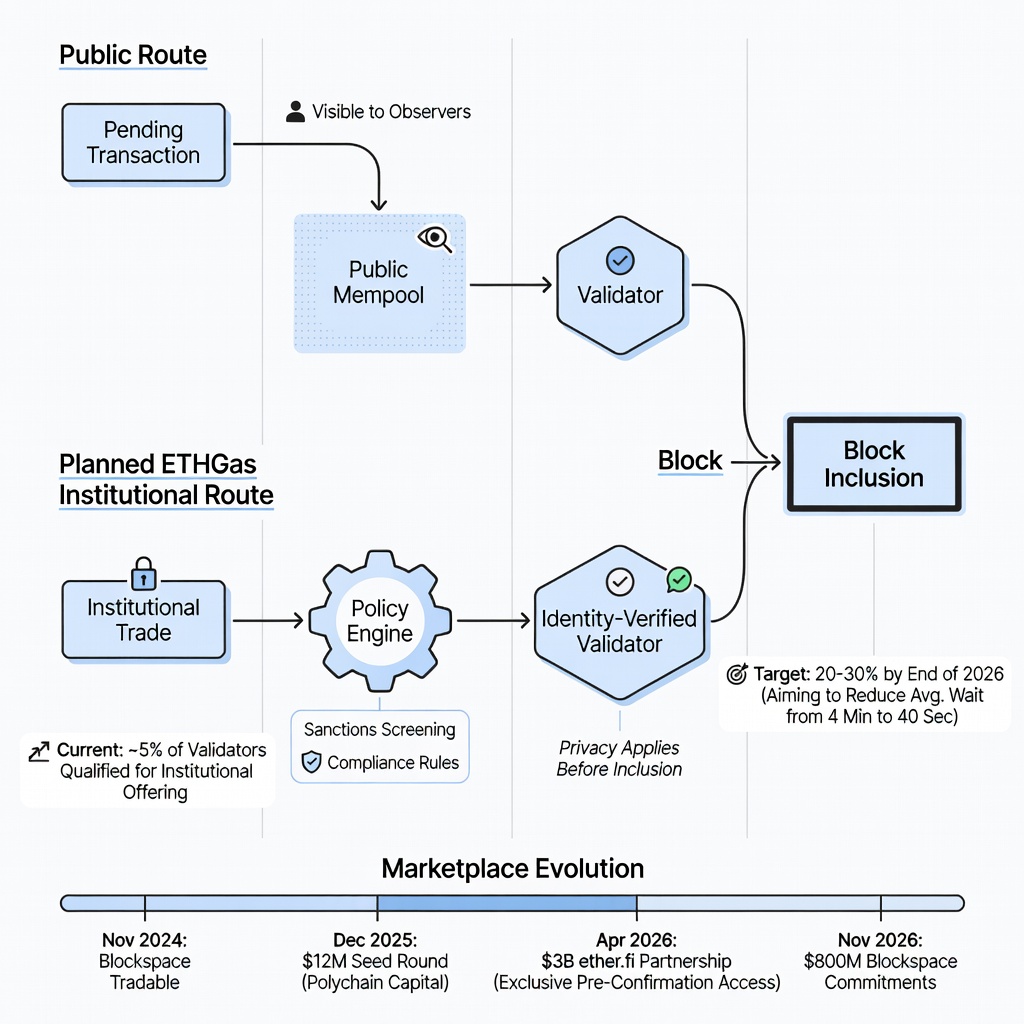
ETHGas plans to let institutions pay identity-verified Ethereum validators to include trades in upcoming blocks without first broadcasting them to the public mempool. The privacy applies before inclusion: traders would avoid exposing a pending transaction in the public queue while they wait for a validator to include it.
ETHGas’s marketplace, where blockspace has traded since November 2024, lets buyers reserve capacity rather than compete for it when they submit a trade. A buyer can reserve an entire block or obtain a promise that a validator will include a particular transaction. That advance assurance is called a pre-confirmation. For institutional transactions, ETHGas uses what it calls a Policy Engine to apply compliance rules during processing, including sanctions screening.
Validator coverage and missed commitments
As of November 24, 2026, only about 5% of Ethereum validators met the requirements for the institutional offering. ETHGas aims to raise that share to between 20% and 30% by the end of 2026. If it reaches that range, the company says the average wait could fall from approximately four minutes to around 40 seconds.
A pre-confirmation does not currently entitle the buyer to compensation if a validator misses its commitment. ETHGas says mechanisms exist that could put a price on missed commitments in the future. Its founders said there had been no significant delivery issues so far.
Marketplace commitments and the ether.fi partnership
ETHGas reported approximately $800 million in blockspace commitments as of early November 2026. In April 2026, it announced a three-year partnership worth about $3 billion that gives ether.fi exclusive access to ETHGas’s pre-confirmation technology.
ETHGas raised $12 million in a December 2025 seed round led by Polychain Capital. The company has also been accepted into the Ethereum Security Subsidy Program and has completed a second independent audit of Commit Boost, the software module validators run to participate in its marketplace.