
Bitcoin exchange-traded funds recorded approximately $4.94 billion in net outflows in November through the time of reporting on 25 November 2026, according to CoinGlass data. With several days left in the month, withdrawals had already surpassed June’s $4.51 billion, the previous monthly record since launch.
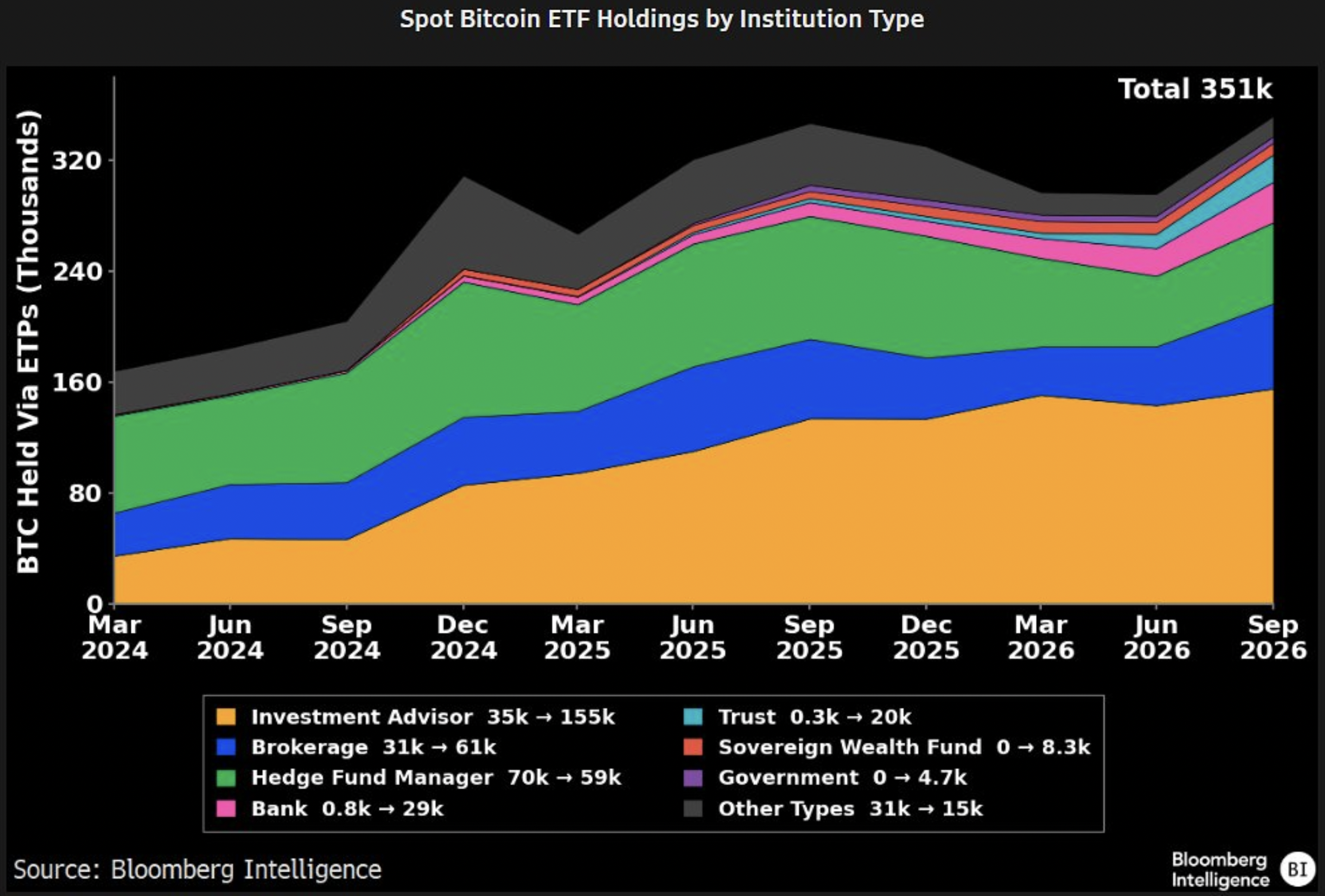
Institutional filings tell a different part of the story. Bloomberg ETF analyst James Seyffart said 2,223 institutional filers reported Bitcoin ETF exposure equivalent to 356,072 BTC, worth approximately $29.77 billion. Those figures measure holdings, not November transactions: they do not establish which investors accounted for the month’s withdrawals.
How November compares with earlier months
The funds recorded net outflows of $1.61 billion in January and $206.52 million in February. Net inflows of $1.32 billion in March and $1.97 billion in April reversed that trend before investors withdrew a net $2.43 billion in May and $4.51 billion in June.
Net inflows resumed in July at $172.43 million, then rose to $3.52 billion in August. September added another $2.65 billion. October marked the turn back to net withdrawals, with $515.03 million leaving the funds ahead of November’s record. Glassnode separately noted that Bitcoin ETF trading volume had fallen below its median since launch.

What institutions reported holding
Investment advisers were the largest group in Seyffart’s figures: 1,863 filers reported exposure equivalent to approximately 160,195 BTC, worth $13.39 billion. Brokerage firms accounted for 59,255 BTC and hedge funds for approximately 58,088 BTC. Banks reported 28,937 BTC and trusts 19,723 BTC.
Reported institutional exposure rose by 56,493 BTC over a one-year period. Over a three-month period, Alex Thorn of Galaxy Research put the increase at approximately 49,229 BTC-equivalent. Wells Fargo’s aggregated filings showed exposure equivalent to approximately 30,549 BTC. Other notable holders included Jane Street, Goldman Sachs, Millennium Management and Morgan Stanley.
Ecoinometrics said November’s ETF flows were tracking its bearish simulation. Its model suggested Bitcoin could revisit the low-$50,000 range if the outflow trend continued. That was a conditional scenario, not an observed price outcome.