The Hong Kong Monetary Authority (HKMA) launched a platform on November 25, 2026, that can settle tokenized bonds in multiple currencies around the clock. In London, JPMorgan, HSBC and StoneX Group tested a different use for digital ownership records: trading fractional interests in physical gold bars without moving the metal. While Hong Kong’s bond platform is operational, the World Gold Council said the London mechanism remains experimental.
Hong Kong: bond issuance through redemption
The CMU Digital Assets Platform brings issuance, secondary-market settlement, coupon payments and redemption onto the distributed ledger of Hong Kong’s Central Moneymarkets Unit (CMU). It can also tokenize conventional bonds. CMU OmniClear helped the HKMA develop the platform and operates it.
The platform uses on-chain delivery versus payment: the bond and cash change hands together, or neither transfer takes place. It connects directly to real-time gross settlement systems and central bank digital currency, and uses cash tokens for 24-hour multicurrency settlement. The HKMA said OmniClear’s roadmap includes funds and other real-world assets, as well as connections to tokenized deposits and regulated stablecoins. Those extensions were not part of the launch.
Separately, BlackRock said on November 24 that it had launched its first tokenized money market fund in Hong Kong and the Asia-Pacific region, the South China Morning Post reported. Professional investors can subscribe to and redeem the BlackRock HKD Digital Liquidity Fund using digital cash, including the HKMA-licensed HKDAP stablecoin. Retail investors must use Hong Kong dollars. The constant-net-asset-value fund, established on November 16 according to BlackRock’s product page, invests in short-term, high-quality Hong Kong dollar money market instruments and deposits. Standard Chartered serves as custodian, administrator and trustee and handles tokenization.
London: testing gold as collateral
Bloomberg reported that JPMorgan, HSBC and StoneX completed the first London trades using a mechanism called “pooled gold interests.” It lets banks use fractional ownership of bullion as collateral without transferring physical bars. The distinction matters in London, where hundreds of billions of dollars in gold change hands weekly, mostly through unallocated contracts rather than ownership of specific bars.
The World Gold Council is also asking UK authorities to include gold in the country’s financial collateral regime. The trades were a test of the mechanism, not a change to that regime.
Europe seeks experiment partners; South Korea considers reserve rules
The European Central Bank invited financial industry groups to apply for experiments under its Appia initiative, Cointelegraph reported. The work covers tokenized deposits and payments, tokenized securities, and governance of shared networks. Applicants must apply jointly as separate legal entities, not individually. Groups may apply for more than one workstream. The first application deadline is December 11, 2026, with later submissions assessed on a rolling basis. The ECB plans to publish findings and a proposed framework in 2028.
In South Korea, Financial Services Commission draft legislation would require overseas stablecoin issuers such as Tether and Circle to establish a local branch or office and register with the commission to issue and redeem stablecoins in the country, according to Digital Asset. The proposal would require issuers to deposit or entrust reserves to local institutions such as banks, separate them from their own property and manage reserves separately for each stablecoin.
An implementing decree would set the reserve scope and permitted management methods, taking account of home-jurisdiction regulation and the amount held and circulating in South Korea. The bill would also require local operating funds and give Korean creditors priority over assets in the country if a Korean branch entered liquidation or bankruptcy. These were proposed obligations, not rules in force.
Market data
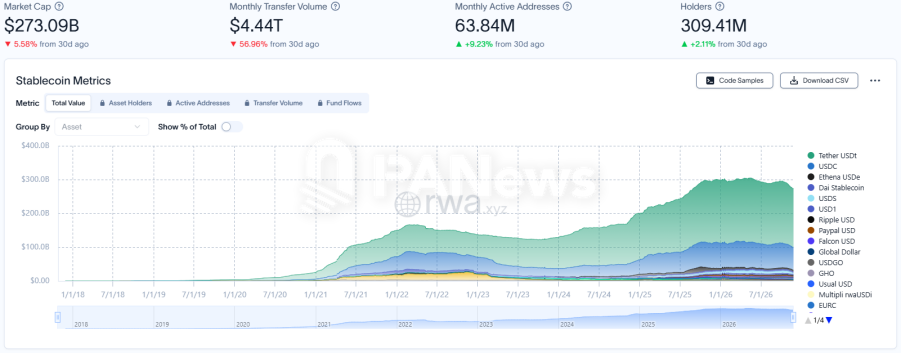
RWA.xyz data for the November 20–27 reporting week showed that the on-chain value of real-world assets and the number of holders moved in opposite directions. The figures below are as of November 27, 2026; changes are relative to the same point a month earlier, not to the start of the reporting week.
| Measure | November 27 figure | Monthly change |
|---|---|---|
| On-chain real-world asset market value | $41.19 billion | −3.75% |
| Real-world asset holders | 5.927 million | +7.3% |
| Stablecoin market capitalization | $273.09 billion | −5.58% |
| Monthly stablecoin transfer volume | $4.44 trillion | −56.96% |
| Monthly active stablecoin addresses | 63.84 million | +9.23% |
| Stablecoin holders | 309 million | +2.11% |
Among the three largest stablecoins, USDT’s market capitalization fell 4.31% and USDC’s fell 2.93%. Ethena’s USDe rose 8.75%.
A separate assessment of USDT’s reserves highlighted the distinction between liquidity and exposure to price swings. About 73% of Tether’s reserves were in highly liquid assets such as short-term US Treasuries, while 27% were in more volatile noncash assets, including gold, bitcoin and equities. Tether had a $7.95 billion excess reserve buffer and recorded $4.5 billion in net operating profit in the first three quarters of 2026. S&P rated USDT’s ability to maintain its peg at 5, its lowest grade. Tether disputed S&P’s assessment framework. Analysts cited the possibility that extreme losses could erode reserve coverage or that market panic could trigger a temporary loss of the peg; neither was reported as having occurred.
Settlement and market access
- Malaysia: Maybank used tokenized deposits on its permissioned blockchain to settle a tokenized Malaysian government bond trade, Ledger Insights reported. The bank held both the underlying cash and the securities in custody. The test followed a March cross-border tokenized deposit payment pilot with Yinson Holdings. Maybank is one of three participants in Bank Negara Malaysia’s Digital Asset Innovation Hub.
- Cross-border corporate payments: StraitsX and OCBC began a pilot to settle stablecoin receipts into companies’ existing OCBC accounts, with NTT DOCOMO ASIA as the first participant. StraitsX handles payment identification, on-chain compliance, reconciliation and settlement through dedicated wallet addresses; OCBC provides the banking relationship and fiat payout channel. Expansion beyond the initial payment scenarios depends on regulatory, compliance and operational requirements.
- Institutional lending: Securitize said eligible investors can use HINC, its tokenized high-yield bond fund with Neuberger, as collateral to borrow USDC, GHO or RLUSD on Aave Horizon.
- US tokenized securities: OKX announced a phased rollout of 113 stocks, ETFs and ETPs on OKXICE TSV, its joint venture with Intercontinental Exchange. It gave a start time of noon US Eastern time on November 23 for eligible US OKX users. Reporting on availability was inconsistent: one account described six crypto-related stocks as the initial offering, while an earlier status check found the landing page still said “coming soon.” The announcement did not establish that all 113 assets were tradable.
OKX said its platform uses Uniswap v4 automated market-maker pools on X Layer, with Securitize providing tokenization infrastructure. It described the stock tokens as backed one-for-one, self-custodied and carrying corresponding dividend and voting rights. OKX said the platform operates under a US Securities and Exchange Commission innovation exemption; it is not a registered exchange or broker and has not received SEC approval. Of the first 62 companies proposed for inclusion, 56 objected, and objections eventually reached 67 companies, including Apple and Nvidia. The objections concerned third-party shareholder records. The SEC exemption documents also identified recordkeeping and pricing risks.
Service changes and funding
Stablecoin services provider KOSH said it would wind down after failing to build a sustainable business and running out of operating funds. It scheduled cards, virtual bank accounts and fiat payouts to stop on November 30, 2026. KOSH said it emailed withdrawal instructions on November 18 and would accept requests through December 15. It was exploring migration options for business customers. Separately, US stock-token platform MSX added spot and contract trading for HD and WDAY.
Global MPC announced $7.5 million in strategic financing for its BNB Chain infrastructure for recording and transferring tokenized mining resources. It named MH Ventures, Mapleblock Capital, Paul Taylor, Genesis Capital VC, Becker Ventures, Titans Ventures and Asva Capital as investors. LART, a BNB Smart Chain protocol focused on recovering lost artworks, recording provenance and bringing physical art into a regulated real-world asset framework, announced a $2.5 million round with IBC Group, x21 Digital, Genesis Capital VC and GaeaVentures.